House No-6, Kamakhya Temple Road, Nursey, Guwahati, Assam, Pin-781009
Mon-Sat: 9.00am To 7.00pm
Follow Us :
House No-6, Kamakhya Temple Road, Nursey, Guwahati, Assam,
Pin-781009
Contact For Support (+03) 456 7898

Training Center

Dolphin Security & Advertising

TRAINING PROGRAMME OF THE SECUIRTY PERSONNEL

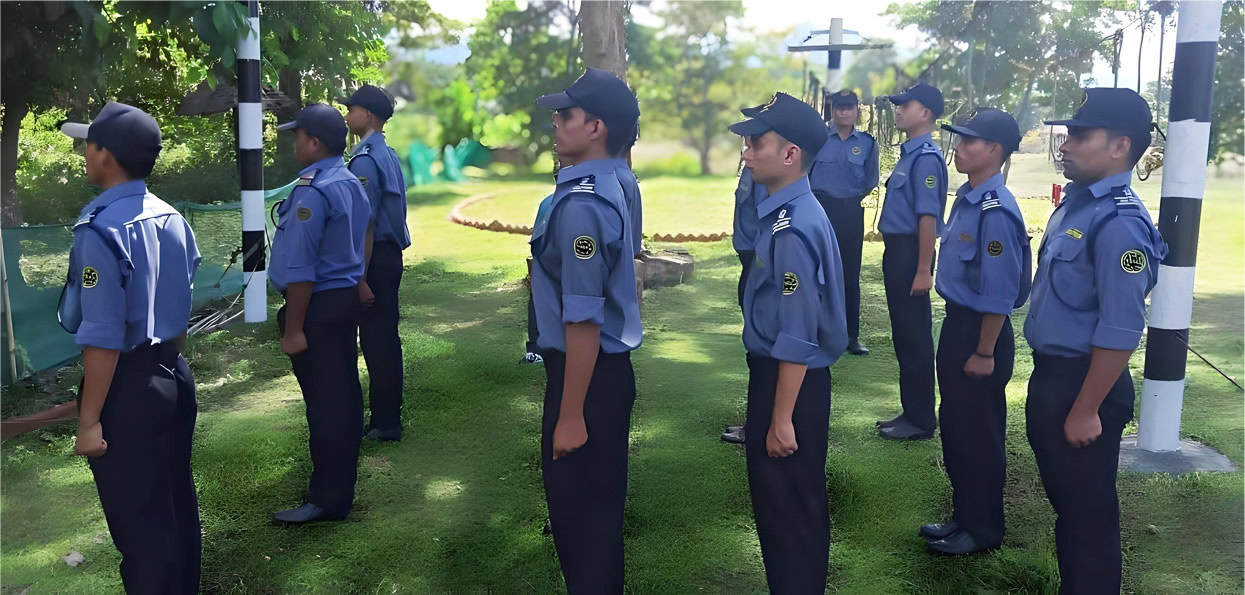
The establishment has its got stat-of-the-Art Training Centres and modern Offices in the heart of the Guwahati City and its adjacent areas for providing Basic & Advanced service related training to its work force and also have modern Tools, Gadgets, equipments and machineries required for Modern Training methodology

Our training center has the capacity to conduct training to 25 persons at a time. It is also to be noted that before engagement of the Security personal we use to provide training both in theoretical & physical training for minimum 100 hours each based on preliminary laws, physical security access control, duties & responsibilities & behavioral approach etc.

The Security Guards and Supervisors are specially trained to maintain their duties and responsibilities as desired and expected by different clients as per their need to safeguard the interest of the life and properties of our valued clients.

Basic Security Training of Security Guards & Supervisors as Follows

SYLLABUS FOR TRAINING OF SECURITY GUARDS

Sl. No. Subject Break up Theory Practical Ex. Defence
Personnel/ Police
Theory Practical
1 Conduct in Public Place Conduct and behaviour of security guard and correct wearing of uniform 04 02 01 ..
2 Physical Fitness Training Hisory of physical training, training tips, various type of exercises, personal hygiene , prevention of injury, daily log,balancing of diets. Obstacles and Lathi drills. 02 20 .. 10
3 Physical Securiy Security, Principal of security (security of personnel), information, material, operation), Security of building and household security 06 10 02 ..
4 Fire Fighting Definition of Fire, Fire triangle, Class of Fire, Prevention of fire, Distinguishing method of fire, type of Fire, extinguishers, Cause of fire, Chemical/ ingredients. 12 06 01 01
5 Crowd Control Type of crowd, significance of crowd, strength of Crowd and methods of controlling. 03 02 01 01
6 Examination/ Identification of documents Type of I. Card, various type of passes, passport and Smart card. 03 .. 01 ..
7 Reading of English Alphabets and Arabic Numerals Identification of documents,Arms licence, travel documents and security Inspection sheets. 06 .. 20 ..
8 Identification of Improvised explosive/devices Working, identification, type, shape and action. 03 03 01 01
9 Basic first Aid Principle of first aid, steps in first aid, Checking for ABC ( Airway, breathing and circulation), procedure for CPR ( Cardio pulmonary re suscitation ), fractures, burns,scalds, beestings,snack and animal bites and fainting etc. 04 03 01 01
10 Disaster Management Types of crisis, response theory and immediate action. 06 03 01 01
11 Defensive Driving Rule and order for safe driving. 05 02 01
12 Small Arms Handling and operation of  non prohibited weapons and small arms. 03 02 01
13 Civil Law Rudimentary knowledge of Indian Penal Code, Criminal Procedure Code, Indian Evidence Act, Right to Private Defence, Procedure of Lodging FIR. 07 03
14 Badges  and Rank of Arm Forces and Civil Police Army, Navy, Air Force and Civil Police. 03 .. 01
15 Arms used in Public and Civil Police Identification of different type of Arms used in Public and Civil Police. 04 02 01
16 Security Gadgets Use of GTMS, Security Alarm,CCTV and screening Equipments. 06 03 01
17 Leadership and Management Only for Supervisors 13 .. 02
18 Bomb Threat Observation, handling of un-identified object, Anti-Sabotage checks, handling equipments and special requirement of those who have to do body protection. 10 03 01 01
19 Visit to site Malls, Factory, Ports, Resort or School 08 03 ..
20 Parade Training Importance of Parade, Savdhan, Vishram, Aram Se, Dahine, Baye and piche mood, stepping to the side, front and rear.  Making single line, double and three Lines with markers, khuli line chal, Nikat line chal, Tej Kadam Tal and Tham, while marching dahine, Baye and piche mood, Samne Salute, Patre ke sath Salute, while marching samne and Sandesh salute, while marching Dahine and Baye salute, while marching dahine and baye dekh, Dhire chal and Tham. Repoirting and salute, Ceremonial parade. 02 26 ..
21 Karate ( Self Defence) History, delicate( weak) points and parts, Basic practice , punch,kick, blocks ( defence), uses of arm and leg as a weapon, attack on face, stomach and grooving label, collar hold, neck hold, moving basic technique ( defence and attack) 02 10 ..
22 Basic of ESIC PF Act's Meaning, Scope, Contribution, How to Apply etc. 04 .. ..
23 Development Soft Skill & Leadership How to improve Listening skill , importance , communication skill , how to improve leadership skill 04 .. ..
24 Quality Management Introduction to ISO 9001: 2008, 14001:2004, 18001: 2007 02 .. ..
25 Basic of PSAR Act. Scope, Importance of Act, 04 .. ..
    Total Periods 125 100 40 16

We Provide a training program to all security personnel before being placed on assignment which also includes:

  • Conduct in public place: in this training we firstly tell all the security guards about how to behalf in public places and with public followed by wearing security guard dress properly
  • Physical Fitness Training& Parade Training: We provide physical training to our security professionals to overcome any kind of physical threats. The physical training includes drill, physical conditioning & unarmed combat.
  • Professional Training: Provides professional training to its security personnel to effectively handle any kind of emergency including personal protection, security patrolling, industrial unrest, liaison with police and filing of FIR, record keeping of men, materials and vehicles.
  • People Skills Training: Provides People skills training to its security personnel to effectively handle all aspects of industrial relations with government departments, customer care etc.
  • Reading of English Alphabets: Before security guards will examine and identify of documents of persons, security guards need to know at least how to read and write in English. That is why we take training of security guards to check whether they know alphabets or not.
  • Examination & Identification of Documents: Provides Examination & Identification of Documents training to security guards to understand how to identify the proper valid identity documents of a person and to detect the duplicate documents of a person
  • Positive Attitude: Holds many sessions to develop a positive attitude in its security personnel to cope with difficult real-life situations without bitterness or any negativity.
  • Environmental Training: Trains its security personnel to be eco-friendly in their outlook and care for the paryavaran (environment)

Physical Training

  • Drill: To enable the trainee to carry out the duties as uniformed security staff in immaculate dress, having smart, crisp movements, responding promptly to orders of superiors in a disciplined manner at all times.
  • Physical Conditioning & Unarmed Combat: To improve physical fitness of the trainee, enabling him to be capable of carrying out sustained work, thereby contributing to a healthy body capable of resisting small illnesses. He learns also learn to handle certain violent situations.

Professional Training

  • Search and Blocking: Provides this training to make the trainees aware of the importance of security patrols in maintaining security and safety of the organization’s premises. At the end of the training session, the trainee is able to prevent thefts and pilferage and other crimes, illegal encroachments, accidents and report any breaches of safety regulations, unauthorized entry at the organization’s premises, particularly at night.
  • Personal Protection: Provides this training to enable the trainees to carry out the tasks of basic unarmed personal protection. After training, the security personnel are able to provide protection to the designated individuals.
  • Emergency Situations and Actions of Security Staff Thereupon: Provides this training to prepare the trainees to be able to recognise an emergency pertaining to fire, bomb threat, dacoity, arson, riot, serious injury, drunkenness and sexual harassment and to take immediate and appropriate action to come to the help of the victims without loss of time.
  • Liaison with Police and Filing an FIR: Provides this training to make the trainees aware of the importance of maintaining good liaison with the local police, and learn how to file an FIR in accordance with the existing laws, rules and regulations.
  • Corporate Office: Provides this training to identify and assess threats to the vulnerable areas and vital points in the corporate office with particular reference to VIPs working there and use the deterrent effect of patrolling there.
  • Industrial Unrest and Right of Private Defence and Legal Aspects: Provides this training to make the trainees aware of legal aspects of crime, their statutory rights of private defence, union activities, rights and limitations and the role of security staff in situations of industrial unrest.

People Skills Training

Today security personnel are not expected to be mere gatekeepers. Keeping this fact in mind, provides appropriate training to make its security personnel flexible and capable to meet the client’s requirements. After this training, the security guard gains an end-client “service” orientation, courtesy, politeness, pleasant demean our and positive attitude.

Social skill is one of those which includes

  • Client and Industrial Relations: Provides this training to make the trainees aware of maintaining proper relations with the public and the organization’s employees. At the end of the training sessions, the trainees shall have elementary knowledge of maintaining good public relations and to resolve various types of inter-personal conflicts.
  • Customer Care

Positive Attitude Training

Attempts to inculcate a sense of positiveness in our personnel. Our goal and hope is that the positive attitude emanating from our staff will enthuse everyone at the client site to bring out the best in all. At the end of the training session, the trainees imbibe respect and love for customers, superiors, colleagues and subordinates; is sensitive about good inter-personal relations, inculcate the habit of following the orders of superiors with no question raised; learn to be enthusiastic and sincere in work; has an urge to improve professionally; learns to maintain positive and happy attitude at home as well as on the job; learns to take pride in the job, and in the Organization; become a positive influence on other colleagues.

  • All our programs lay stress on positive attitude.
  • Attitude emanates from the thinking process.
  • The beads of academic and professional subjects in our programs are strung together by the thread of positive attitude. This, we believe, acts as a powerful lever for change and the benefits go far beyond the ability to do the job in hand.
  • It is more about changing values and behaviour. This encourages employees to think about their role in the organization in a wider context.
  • Overall, the employees feel valued by the organization and are therefore more loyal to it.
  • Thus, by the end of the program, each of our security guards is an effective performer plus an asset to your organization.
  • Our programs create not only good professionals but also good human beings.

Provides this training to make the trainees aware of the fundamental importance of caring for the customers and maintaining best relations with them so that they will be able to conduct themselves well and give an excellent first impression to every customer. To be aware of personal hygiene, displaying positive and helpful attitude towards the customer and to be careful about customers.

Environmental Training

Our guards are made to realize the importance of being a part of the biosphere. As such, they are taught to treat resources with respect conserve and not waste – and wherever possible contribute towards the cause of protecting the environment.

Specialized Training

  • Fire Prevention and Fire Fighting: We provide special training to our security personnel to make them aware of the causes of fire, the types of fire, operate various types of fire extinguishers and other equipment generally used for putting off fire. At the end of the training session, the trainee is able to know what to do in case of a fire emergency, their duties as part of a fire fighting party, cordon party, salvage party, rescue party, take precautions to prevent out-break of fire and if required be able to organise the existing manpower in these groups.
  • First Aid and Evacuation Procedure: We provide special training to have elementary knowledge of serious accidents and serious illnesses, give first aid to the victims under the circumstances of serious burn injury, gas victims, victims of de-hydration, cardiac attack and electric shock. At the end of the training session, the trainee is able to obtain assistance to evacuate the victims for specialised treatment and have knowledge of contents and usage of first aid box.
  • Traffic Control: We prepare all personnel to carry out one of the most important assignments that they frequently do i.e., Access and Traffic Control. The main purpose of this training is to make them able to handle all visitors, government personnel, contractors, employees and their relations, casual labour, and others on the organization’s premises; control and account for the keys to the organization’s property and premises; control incoming and out-going materials with the view to avoid pilferage; control the entry and exit of all types of vehicles and maintain records on the computer or in registers.
  • Handling Threat of Bomb/Explosive: We provide special training to our security personnel to take precautionary steps in case of threat of bomb/explosives, reduce the damage as far as possible, obtain assistance from government agencies concerned, lead the organization’s employees to safety (crowd control), assist the police bomb disposal squad in their investigation of the threat and/or explosion.

Other Training

Besides basic and specialized training, we also provide other training modules like supervisory training, pre-job training and refresher training for our security personnel.

  • Supervisory Training: We provide supervisory training to those security personnel found capable of supervisory duties. This training module covers supervision, leadership, human relationship management, substance abuse detection and counseling, mentoring, psychological aspects of leadership, emergency response, etc.
  • Pre-Job Training: According to each client’s requirements, all security personnel are given appropriate pre-job orientation & training. This training is based on the client’s specifications, job complexity and level of responsibility.
  • Refresher Training: We give mandatory refresher training to all our security personnel twice a year. More frequent training is provided as per the client’s needs and the performance of each specific individual.

Role and responsibility of security officer and their Training classes with topics

  • Knowledge of law (civil and criminal).
  • Customer service.
  • Access control.
  • Reporting.
  • Avoid conflict and reducing risks.
  • Managing aggression.
  • Safety consciousness and safe working practices.
  • Care of equipment and tools.
  • Punctuality, discipline and honesty.
  • Concern for quality of service.
  • Respect for rules and regulations.
  • Concern for health and hygiene.
  • Cordial relationship, Cooperation and team work.
  • Positive attitude and behavior.
  • Responsibility and accountability.
  • Learn continuously.
  • Communication skills.
  • Concern for environment and waste disposal.
  • Coordination with local administration including law and order agencies.
  • Multitasking capability.

Following competencies should also be developed during level-II and higher courses:

i. Pre-emptive.
ii. Motivating and deriving the best out of team.
iii. Post incident consideration.
iv. Verbal and non verbal communication.
v. Identify different types of behaviors.
vi. Ability for planning, organizing and coordinating.

The recognition of prior learning that provides evidence of the achievement of the competencies for the qualification. Methodology The training methods to be used should be appropriate to the development of competencies. The focus of the programme is on “performing” and not on A combination of an approved training programme plus recognition of prior learning including credit transfer; Or  An approved training programme; Or

vii. Creative thinking, problem solving and decision making.
viii. Leadership.
ix. Ability to bear stress.
x. Capacity to negotiate.

Duration of the Programmes: Time taken to gain the qualification will vary according to the pathway taken and will be kept very flexible for persons with different backgrounds and experience. Duration has been prescribed in hours in the curriculum of individual module, which are based on the content and requirements of a MES Module. However, some persons may take more time than the prescribed time. They should be provided reasonable time to complete the course. Pathways to acquire Qualifications: Access to the qualification could be through